
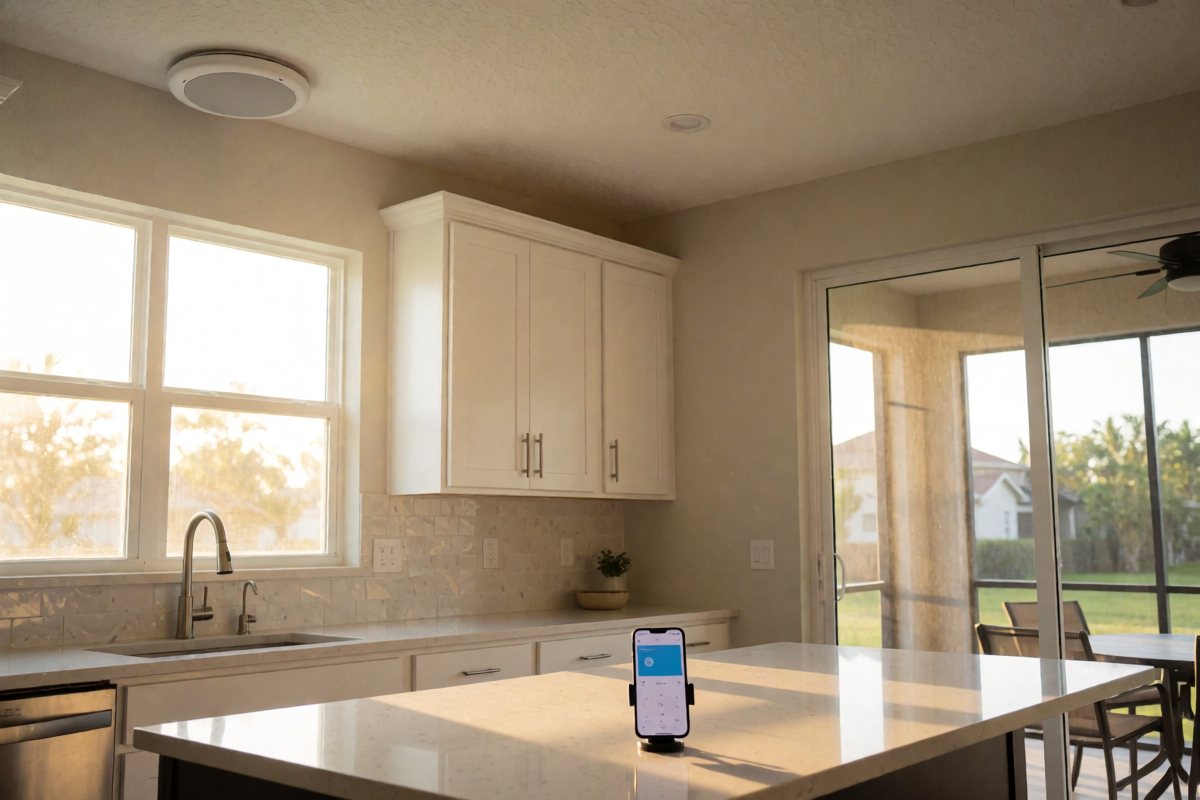
Whole-home audio lets background music follow you from the kitchen to the pool cage, but it is one of the most commonly half-done projects in a Tampa Bay home. Get it right and every room sounds clean without a single wire snaking across the floor; get it wrong and you are stuck with one muffled speaker in the kitchen, a breaker panel that trips, and a wall full of poorly matched equipment. The difference between the two usually comes down to planning, component quality, and who installed it.
How Whole-Home Audio Works
A whole-home audio system routes music from a central source to multiple rooms through a network of amplification, a distribution unit, and speakers wired into each room. Unlike dropping a Bluetooth speaker in every space, the system lets you play the same song everywhere or different music in each room, all controlled from your phone or a wall panel.
The heart of a modern system is a platform such as Savant or Control4, which ties the audio into the rest of your home so you can group rooms, set schedules, and adjust volume per zone. Lower-end systems use a dedicated multi-zone receiver with pre-out connections feeding each room. For a home in St. Petersburg's older waterfront neighborhoods or newer Wesley Chapel builds, the architecture changes what kind of system makes sense.
- Distributed platform systems: Central processor, app control, whole-home integration, higher cost.
- Multi-zone receivers: One receiver feeds several rooms, more affordable, less elegant control.
- Speaker-level distribution: Signal split to rooms without extra amplification, budget option, weaker control.
Sizing and Room Coverage
The first real decision is how many rooms you actually want to cover and how the system is zoned. A common layout covers the main living areas — kitchen, family room, primary suite, and a covered outdoor space — with four to six zones. Whole houses with multiple floors and guest suites may call for eight or more.
Volume of space matters as much as room count. A two-story block home with 9-foot ceilings distributes differently than a tall great room, and a stucco home near the bay reflects sound differently than a drywall-and-studywall build. Your installer should measure each room, not just count doors, to size speakers and amplification correctly.
A practical rule of thumb: budget for the rooms you spend the most time in, then expand later. Adding a zone to a platform-based system is usually cheap; retrofitting a receiver-based system into finished walls is not.
Savant, Control4, and System Platforms
The biggest brand decision in a whole-home audio system is the platform. Savant and Control4 dominate the premium market and integrate audio with lighting, climate, security, and entertainment in one app. This is where the polished luxury feel comes from — changing the music in the kitchen, dimming the lights, and pulling down shades, all from one interface.
- Savant: Known for clean design, strong music-service integration, and a modern app interface. Popular for new construction and renovations.
- Control4: Deeply customizable, excellent for homes that want audio tied to security, shading, and automation scenes.
- Receiver-based (Sonos, Denon, Yamaha): Lower cost, easier to DIY, but limited whole-home reach and integration.
Both premium platforms require professional installation and programming. You cannot fully set up a Control4 or Savant system yourself and expect it to feel seamless. That integration is exactly why the easy, elegant control is possible.
Speaker Placement and Quality
Speakers are what you actually hear, and placement drives the sound more than any spec sheet. In a home with tile floors and hard stucco surfaces common across Tampa Bay, sound bounces more, so proper speaker choice and placement soften the acoustics. In newer drywall construction, speakers can sound brighter if not tuned.
Ceiling speakers are the standard for whole-home audio because they stay out of the way and distribute evenly. Key specs to understand:
- Wattage rating: Match to your amplifier output. Underspeakers get muddy; overspeakers waste money.
- Impedance: Must align with the amp and distribution system to avoid distortion or tripped breakers.
- Coverage radius: Typical ceiling speakers cover roughly 150–400 watts distributed depending on design, listening for clear sound across the room.
Wiring matters too. Proper gauge speaker wire run cleanly through the walls avoids signal loss over distance. An installer who runs cheap wire or daisy-chains connections across long runs will leave you with thin, inconsistent sound.
Outdoor and Indoor-Outdoor Continuity
Because Tampa Bay homeowners live outdoors much of the year, integrating outdoor audio into the whole-home system pays off. A covered lanai, screened pool cage, or bayfront patio can carry music from the same source as the interior, so the kitchen and the lounge area share one system.
Outdoor speakers are rated for heat, humidity, and salt air near the water. St. Petersburg and the westshore corridors sit close enough to the bay that salt corrosion is a real factor on exposed equipment. Use speakers rated for damp, salty environments and keep the amplifier in a conditioned or shaded space to extend its life.
What to Look For in a Contractor
Whole-home audio is a trade within a trade. The right installer sources quality components, runs clean wiring, and programs the platform so the whole thing actually works the way you imagined. The wrong one leaves you with a wall of gear that beeps but never quite sounds right.
- Licensing: In Florida, AV and structured-wiring work often falls under the broadcast and television contractor license or an electrical trade. Ask to see their license and verify it.
- Insurance: Require general liability and workers' compensation proof before any work begins.
- Platform experience: Confirm they install and program Savant or Control4 regularly, not occasionally.
- References: Ask for recent whole-home projects in homes similar to yours.
Questions to ask:
- How many rooms can this system cover, and can I add zones later?
- Do you program the app so I can control it myself?
- What happens if a speaker or amp fails?
Warning signs: a bidder who names a low price without visiting the home, someone who pushes a single brand without explaining why, or anyone who cannot explain how they will handle room acoustics and wiring.
What to Expect During the Project
A proper whole-home audio install happens in phases. During rough-in, before drywall goes up, the installer runs speaker wire and cuts holes in the ceiling and walls. This is the cheapest time to add zones, so if you are renovating, do it now.
Once wiring is in place, the distribution unit, amplifier, and platform processor are mounted, usually in a closet, garage, or utility space. Then speakers are fitted, and the final phase is programming — setting each zone, linking your music services, and building the app controls.
Expect some dust, some holes, and a few days of work across an older home or a larger build. A quality installer leaves you with a working system, a clean app on your phone, and a brief on how to use it. Plan for the main run to take several days to a week depending on home size, with smart-home integration adding more time if you are bundling lighting, shading, and security into the same platform.